The Dilemma of Free Speech in France: Terrorism Advocacy or Injustice?
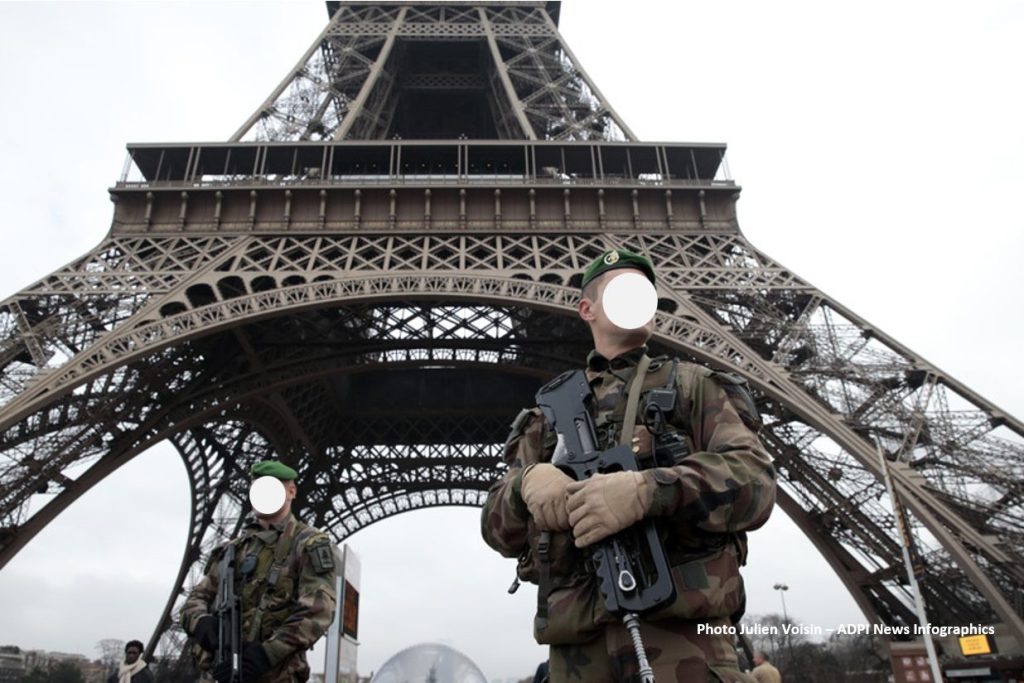
Soldiers from Operation Vigipirate on patrol near the Eiffel Tower in Paris. (Illustration only)
Since 2014, Article 421-2-5 of the French Penal Code, introduced by the anti-terrorism law, has defined the crime of advocating terrorism. Designed as a response to the 2015 attacks, this law has become a cornerstone of France’s counterterrorism policy. However, growing concerns have emerged about its impact on free speech.
While its goal is to prevent speech that incites violence, its controversial application raises fundamental questions about democracy. By criminalizing statements without explicit calls for violence, the law risks restricting public debate and limiting freedom of thought—a core principle of any democratic society.
A Law with a Vague Scope
Some call for the law’s repeal, while others advocate for revising its scope. The definition of “advocating terrorism” remains vague, leaving room for arbitrary interpretations. In recent years, several cases have highlighted prosecutions against individuals for ambiguous statements, social media missteps, or provocative comments.
Former anti-terrorism judge Marc Trévidic, who initially supported the law’s implementation, has since distanced himself from it due to its perceived misuse. According to him, the law has sometimes been applied to punish dissenting opinions rather than address actual threats.
A Threat to Criticism and Satire
Critics argue that the law is being weaponized to stifle legitimate dissent, satire, and even artistic expression—a paradox for a country that prides itself on being a champion of free speech.
Recently, public figures have been targeted for their political stances, notably European Parliament member Rima Hassan. Born in a Palestinian refugee camp in Syria and holding a master’s degree in international law, Hassan is a well-informed voice on issues of human rights and national identity. Yet, her views have repeatedly come under attack, with some attempting to label them as advocacy for terrorism. This use of the law to suppress political criticism raises concerns about the limits being placed on democratic debate.
Reevaluating the Balance Between Security and Freedom
Since 2015, France has implemented a series of measures that have expanded the powers of law enforcement and intelligence agencies under the banner of counterterrorism. While these efforts aim to ensure national security, they have also restricted fundamental freedoms.
The terrorism advocacy law exemplifies this trend: in its current form, it risks deterring public expression and fostering a climate of suspicion, contradicting democratic principles. A revision that narrows its scope to explicitly direct incitements to violence would provide better protections for fundamental freedoms without undermining security priorities.
Failures in Counterterrorism?
Another unresolved issue is the effectiveness of surveillance measures in preventing attacks. Between 2015 and 2016, more than 200 people were killed in terrorist attacks, with countless others injured. How did intelligence services fail to anticipate them? Was it due to a lack of resources, flawed reforms, or a creeping privatization of domestic intelligence? Multiple factors could be at play.
Intelligence professionals, particularly within the DGSI (Direction Générale de la Sécurité Intérieure) and DGSE (Direction Générale de la Sécurité Extérieure), stress that counterterrorism efforts depend primarily on early prevention. Yet, the emphasis on post-attack repression raises serious questions about whether France’s security strategy is truly focused on preempting threats.
A Politically Sensitive Issue
Confronting these failures head-on would mean holding accountable certain political figures who are still in office—a highly sensitive topic. This reluctance to engage in serious scrutiny has fueled persistent unease and created fertile ground for populist rhetoric. The far right, gaining momentum in France, has seized upon these tensions for electoral advantage.
For a nation that prides itself as the “country of human rights,” France now stands at a crossroads. How far should it go to protect security without compromising its core principles? The debate over the terrorism advocacy law is not just a legal issue—it is a test of the country’s commitment to civil liberties in an era of mounting security concerns.
Note :
The real issue is not just the 2015-2016 wave of attacks but what enabled them in the first place. If we acknowledge that such events can only be prevented through effective intelligence work, then the failure of the authorities warrants deeper scrutiny. Yet, this debate is largely avoided, as it would call into question recent strategic and political decisions.
Rethinking counterterrorism policy means addressing the delicate balance between security and civil liberties. This fundamental issue cannot be sidelined for electoral convenience.
Acronyms:
• DGSI: General Directorate for Internal Security (France’s domestic intelligence agency)
• DGSE: General Directorate for External Security (France’s foreign intelligence agency, equivalent to the British MI6 or the American CIA, formerly SDECE)